
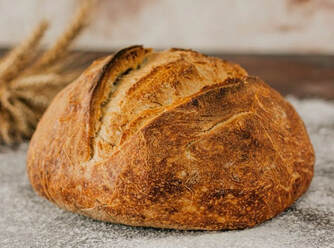
I've dabbled with bread making a number of different times over the years, from making my own sourdough with wild yeasts, to regular yeasted breads, to even using a breadmaker. I've had varying degrees of success, but never really felt I mastered it - especially with sourdough, which was never quite the texture I wanted. But this summer, I've revisited the crusty goodness of homemade sourdough to a greater extent than I have in years.
It all started several months ago when I visited a good friend whom I hadn't seen in a while, and she served me hot, fresh sourdough bread right out of the oven. It was a revelation - warm, soft, and chewy, with the perfect crust! I ate so many slices I barely had room for the rest of the meal!
I raved about it so much that, at the end of the visit, she poured some of her sourdough starter into a jar and sent it home with me. I made my own loaf a couple of days later, and while it was good, it couldn't match hers.
I reached out to her for ideas and also revisited my old sourdough recipe that I had made years ago. By combining these tips, I began to gradually improve my results with each batch. In doing so, I have learned a lot, and have enjoyed lots of fresh bread throughout the summer!
I've also experimented with using up excess starter, though my favorite way to use it is these amazing and super easy pancakes! (Even my husband loves them, and he's not usually a pancake fan.)
Below is my working recipe, as well as some lessons I have learned along the way:
It all started several months ago when I visited a good friend whom I hadn't seen in a while, and she served me hot, fresh sourdough bread right out of the oven. It was a revelation - warm, soft, and chewy, with the perfect crust! I ate so many slices I barely had room for the rest of the meal!
I raved about it so much that, at the end of the visit, she poured some of her sourdough starter into a jar and sent it home with me. I made my own loaf a couple of days later, and while it was good, it couldn't match hers.
I reached out to her for ideas and also revisited my old sourdough recipe that I had made years ago. By combining these tips, I began to gradually improve my results with each batch. In doing so, I have learned a lot, and have enjoyed lots of fresh bread throughout the summer!
I've also experimented with using up excess starter, though my favorite way to use it is these amazing and super easy pancakes! (Even my husband loves them, and he's not usually a pancake fan.)
Below is my working recipe, as well as some lessons I have learned along the way:
Homemade Sourdough Bread Recipe
Total Time: Approximately 24 hours
Active Time: 25 minutes
Baking Time: 35 Minutes
Ingredients (makes one medium Dutch oven-sized loaf):
Instructions:
Tips for Success:
I've learned a lot during my "Summer of Sourdough," and here are some of the most important lessons for a better loaf.
1. Your starter must be ACTIVE. This means, it can't have been sitting, neglected, in the back of the fridge for a week or two if you want good results. My bread still isn't as good as my friend's even though I'm using the same starter she gave me, because she has a large family and makes bread almost daily. I only make it once every week or two, so you need to keep feeding your starter regularly if you're not making bread very often. I usually feed mine about 3 times per week, BUT I learned a very helpful tip from a sourdough baker I followed online that has helped a lot. If you're not feeding your starter daily, take it out of the fridge 2 days before baking and keep it at room temperature, feeding it small amounts (1/4 cup of flour + 1/4 cup of filtered/chlorine-free water) twice daily. Stop feeding at least 6 hours before you mix up your sponge.
2. Kneading is important! When I first started making this bread, I was only kneading it for about 5 minutes, until it felt smooth and not sticky. It was decent bread, but it didn't seem to be rising very much, and the texture wasn't as chewy as I liked. The online baker mentioned that longer kneading is required to develop the gluten, and she suggested the windowpane test as a good gauge of whether your dough is ready. I've found it takes about 15 minutes (give or take) for my dough to reach that point. This has made a huge difference, and the texture and rise of my loaves are MUCH improved! (You may find you don't need to knead as long if you are using only white flour without any whole wheat flour, but I much prefer whole wheat and don't mind the kneading.)
3. Crust development isn't that tricky. My friend who got me back into sourdough baking suggested adding a couple of ice cubes to the pot when placing your bread in the oven. This creates steam inside the pot and develops a lovely, shiny, brown crust. I do agree that this works well. However, I'm not sure if it is because our Dutch oven is fairly old, but I've found that the loaf virtually fuses to the pot when I do this. A few times, I thought I was going to have to get a hammer and chisel to get it out, but eventually succeeded although bending our metal spatula in the process! I tested this several times, and the ice was definitely the culprit. However, I've found that as long as I place a lid on the Dutch oven for the first 25-30 minutes and then remove it, the loaf still develops a nice crust - and it pops right out of the pot like a dream when done.
BONUS: Storage Tip: The main problem I had with making sourdough bread this summer is that we don't eat it fast enough. I have had problems with eating bread in the past as it can sometimes make my acid reflux worse. I've read that sourdough is easier on the digestion, and it does seem to be fine - as long as I don't eat it every day. This poses a problem though, as within about 3 days on the counter (even wrapped in a towel in a bread basket), the bread starts to go hard and stale. I'd end up throwing 1/3 of the loaf to the chickens before the end of the week.
Then, I read a tip online that changed everything. (I seriously can't believe how well this works.) Someone suggested placing the loaf inside a paper bag, and then inside a plastic bag, and storing in the refrigerator. I tried this with the last loaf I made on the second day after baking, and it worked like a dream! The paper bag absorbs the moisture escaping the loaf so it doesn't get soggy, but the plastic keeps it from evaporating completely. I've found it works best if I remove the bread from the refrigerator 1/2 hour or so before slicing (leaving it inside the bags). Then, I just slice off what I want to eat and toast it lightly in the toaster oven to bring the crispness back to the crust.
I finished the last of the loaf over a week and a half after it was baked, and it still tasted ALMOST like fresh-baked! I'll never store homemade bread any other way again.
So there you have it - everything you need to make your sourdough bread baking endeavors a success! :-) I encourage you to give it a try, and let me know how it turns out for you!
To your health (and to good, real, homemade food),
Rose.
Total Time: Approximately 24 hours
Active Time: 25 minutes
Baking Time: 35 Minutes
Ingredients (makes one medium Dutch oven-sized loaf):
- 1 cup sourdough starter
- 1 cup filtered (or chlorine-free) water
- 1 tsp kosher salt
- 1 1/2 cups bread flour
- 1 cup fine-ground whole wheat flour (white whole wheat is also excellent if you can find it)
- 1/2+ cup all-purpose flour (for kneading)
Instructions:
- Remove your sourdough starter from the refrigerator several hours in advance (or the night before) and allow to come to room temperature.
- Add your starter and the water to a large mixing bowl and stir until well combined.
- Add the flour and put the salt on top, then mix thoroughly with a sturdy wooden spoon. The dough should start to pull away from the edges of the bowl. If it still seems too sticky, add a bit more flour, about 1 TB at a time, until it forms a rough dough (this is called your "sponge").
- Scrape the sides of the bowl, forming a rough ball in the center. Cover the bowl with a clean dish towel and set in a warm place for several hours. I usually let mine go for at least 3 hours, but more is fine, too. I've gone up to 6, but it can start to dry out, so don't go much longer than that.
- Once dough has risen to at least double in size, scrape it out of the bowl onto a well-floured surface, and knead for approximately 15 minutes. (You can also use a stand mixer with a dough attachment, but personally, I love kneading and have never tried it this way, so I can't speak to it.)
- Kneading Process: Fold the dough in on itself and turn the ball 1/4 turn after each fold. It takes a little practice to get smooth at it, but once you get the hang of it, it's very easy, and also a very fun and meditative activity! Sprinkle more flour on the kneading surface as needed to keep it from sticking.
- Continue to knead until the dough is smooth and elastic, and passes the "windowpane test." To conduct the windowpane test, pull a small ball of dough off your main lump, and try to stretch it thin enough to see light pass through it without it tearing. Again, this can take a bit of practice, but eventually, you'll start to learn how many minutes you need to knead it to reach this point.
- Form your kneaded dough into a smooth ball (which it should be already just from kneading), and place it in a large, oiled, glass bowl. Cover with plastic wrap (we use these reusable silicone bowl covers), and place in the refrigerator overnight.
- When ready to bake, pre-heat the oven to 425-degrees WITH a cast-iron Dutch oven inside (you don't need to put the lid on). While the oven is heating, remove your covered bowl of dough from the fridge and let sit at room temperature.
- Remove the Dutch oven from the oven and sprinkle a bit of oil inside (I just squirt it around the outside edge and it slides down to coat the bottom).
- Take your ball of dough out of the bowl, and carefully place it in the bottom of the Dutch oven. Score the top with a sharp knife. If desired, you may place a couple of ice cubes on top of the dough*, and then place the lid on the Dutch oven.
- Carefully transfer back to the oven, and bake for 25 minutes. Check at this point, and if it still looks very pale, bake an additional 5 minutes. Then, remove the lid, and continue to bake for another 10 minutes to allow it to finish browning.
- Remove the Dutch oven from the oven and immediately remove your loaf and transfer it to a rack to cool. Allow to cool for at least 30 minutes before slicing (I know it's hard, but cutting too early will allow the steam to escape and the inside may get gummy, so it's worth the wait!)
- Slather with butter and your favorite jam and enjoy! :)
Tips for Success:
I've learned a lot during my "Summer of Sourdough," and here are some of the most important lessons for a better loaf.
1. Your starter must be ACTIVE. This means, it can't have been sitting, neglected, in the back of the fridge for a week or two if you want good results. My bread still isn't as good as my friend's even though I'm using the same starter she gave me, because she has a large family and makes bread almost daily. I only make it once every week or two, so you need to keep feeding your starter regularly if you're not making bread very often. I usually feed mine about 3 times per week, BUT I learned a very helpful tip from a sourdough baker I followed online that has helped a lot. If you're not feeding your starter daily, take it out of the fridge 2 days before baking and keep it at room temperature, feeding it small amounts (1/4 cup of flour + 1/4 cup of filtered/chlorine-free water) twice daily. Stop feeding at least 6 hours before you mix up your sponge.
2. Kneading is important! When I first started making this bread, I was only kneading it for about 5 minutes, until it felt smooth and not sticky. It was decent bread, but it didn't seem to be rising very much, and the texture wasn't as chewy as I liked. The online baker mentioned that longer kneading is required to develop the gluten, and she suggested the windowpane test as a good gauge of whether your dough is ready. I've found it takes about 15 minutes (give or take) for my dough to reach that point. This has made a huge difference, and the texture and rise of my loaves are MUCH improved! (You may find you don't need to knead as long if you are using only white flour without any whole wheat flour, but I much prefer whole wheat and don't mind the kneading.)
3. Crust development isn't that tricky. My friend who got me back into sourdough baking suggested adding a couple of ice cubes to the pot when placing your bread in the oven. This creates steam inside the pot and develops a lovely, shiny, brown crust. I do agree that this works well. However, I'm not sure if it is because our Dutch oven is fairly old, but I've found that the loaf virtually fuses to the pot when I do this. A few times, I thought I was going to have to get a hammer and chisel to get it out, but eventually succeeded although bending our metal spatula in the process! I tested this several times, and the ice was definitely the culprit. However, I've found that as long as I place a lid on the Dutch oven for the first 25-30 minutes and then remove it, the loaf still develops a nice crust - and it pops right out of the pot like a dream when done.
BONUS: Storage Tip: The main problem I had with making sourdough bread this summer is that we don't eat it fast enough. I have had problems with eating bread in the past as it can sometimes make my acid reflux worse. I've read that sourdough is easier on the digestion, and it does seem to be fine - as long as I don't eat it every day. This poses a problem though, as within about 3 days on the counter (even wrapped in a towel in a bread basket), the bread starts to go hard and stale. I'd end up throwing 1/3 of the loaf to the chickens before the end of the week.
Then, I read a tip online that changed everything. (I seriously can't believe how well this works.) Someone suggested placing the loaf inside a paper bag, and then inside a plastic bag, and storing in the refrigerator. I tried this with the last loaf I made on the second day after baking, and it worked like a dream! The paper bag absorbs the moisture escaping the loaf so it doesn't get soggy, but the plastic keeps it from evaporating completely. I've found it works best if I remove the bread from the refrigerator 1/2 hour or so before slicing (leaving it inside the bags). Then, I just slice off what I want to eat and toast it lightly in the toaster oven to bring the crispness back to the crust.
I finished the last of the loaf over a week and a half after it was baked, and it still tasted ALMOST like fresh-baked! I'll never store homemade bread any other way again.
So there you have it - everything you need to make your sourdough bread baking endeavors a success! :-) I encourage you to give it a try, and let me know how it turns out for you!
To your health (and to good, real, homemade food),
Rose.


 RSS Feed